Showing posts with label Car Concept. Show all posts

Wednesday, September 22, 2010

2011 BMW Alpina B7

In today's consolidated and homogenized global auto industry, Alpina is an odd duck. Based in the southern German town of Buchloe, not far from Munich, the company started taking form back in 1961, when a German entrepreneur called Burkard Bovenspielen began to diversify the family typewriter company into an activity he was more passionate about—making high-performance automobile components. By the late 1980s, the company had focused on its current business: modifying BMWs (BMW:GR) to improve their performance and reselling them through BMW dealers. Mercedes' AMG division has similar roots, the difference being that founder Hans-Werner Aufrecht sold AMG to Mercedes in the 1990s, while Alpina remained independent.
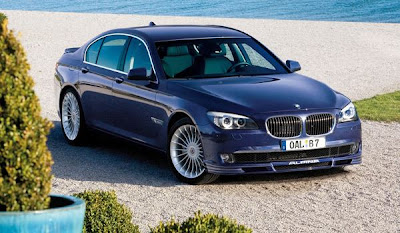
2011 BMW Alpina B7
I recently test-drove the 2011 BMW Alpina B7, which hit dealerships in May and is the only Alpina model sold in the U.S. It's quite a car. If you've ever wondered why there's no high-performance "M" version of the 7 Series, as there is of most other BMW models, it may be because of Alpina. The B7 lineup consists of extensively retooled and upgraded versions of the BMW 750i, the long-wheel-base 750Li, and the all-wheel-drive versions of those vehicles. Alpinas are not only quicker and sportier but offer smoother riding than the equivalent BMW production models. They're also among the most exclusive cars on the market: Alpina expects to sell only around 1,000 B7s annually, about 400 of them in the U.S.

Alpina makes extensive mechanical modifications to the 7 Series. For starters, BMW's 4.4-liter V8 engine is significantly tweaked, with enlarged turbos, high-performance pistons, reinforced cylinder heads, and other modifications that raise horsepower to 500 and torque to 516 ft./lbs. (up from 400 hp. and 450 ft./lbs. of torque for the BMW 750i). Cooling capacity is dramatically expanded, the engine fan is enlarged and the rear differential has a shell made of cast iron, rather than aluminum, to improve heat transfer. Enlarged brakes are added, as are big, beautiful 21-in. spoked wheels clad with Michelin performance tires. Special front and rear spoilers and a new front fascia are added, too.

The car's springs are stiffened and the chassis lowered a fraction of an inch closer to the road. BMW's electronic suspension system is reconfigured to emphasize the difference between the "comfort," "normal," and "sport" settings. BMW's six-speed automatic transmission is beefed up and sport-tuned via Alpina's proprietary shift controls.

In width, length, interior space, and luggage capacity, the B7 is comparable to an equivalent BMW (which is to say the B7 is roomy and has a 14-cu.-ft. trunk). The classic paint job is a metallic Alpina blue, but the B7 is also offered in all the colors the 7 Series comes in.

The Alpina comes with all of a BMW's standard safety gear, including a full complement of air bags and stability and traction control. Fuel economy is similar, too. The B7 is rated to get 15 miles-per-gallon in the city and 21 on the highway. (City mileage drops to 14 with all-wheel drive.) That's about the same as the 2011 BMW 750i, which is rated at 15/22 with rear-wheel drive, and 14/20 with all-wheel drive.

Not surprisingly, however, an Alpina is considerably pricier than a comparable BMW. The B7 starts out at about $124,000, including destination and gas-guzzler taxes—about $40,000 more than a 2011 BMW 750i. Add $3,000 to the B7's price for all-wheel drive and $3,900 for a long wheel base. However, the B7 comes packed with around $14,000 worth of standard equipment that is optional on a comparable BMW (heads-up display, premium sound system, full leather interior, and so forth), reducing the real price premium.

Tuesday, September 7, 2010

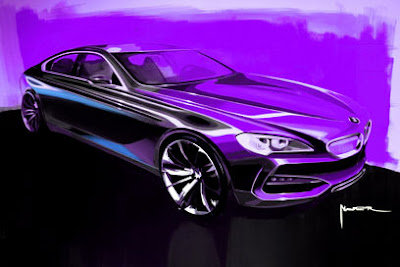
BMW 4-Door CLS Rival

MW 4-Door CLS Rival
It’s rare for BMW to be caught napping. But the German firm has only just given the green light to its stunning four-door Gran Coupe, which will take aim at the Porsche Panamera, Mercedes CLS and Audi A7.

Product development chief Klaus Draeger announced the decision at BMW’s Design Night in Munich, where the Gran Coupe concept made its European debut.

The car will be positioned in the range close to the new 6-Series, and aimed both at those who would like a more practical version of the 6-Series two-door, and at owners considering a 7-Series, but who prefer to drive themselves.

Styled by BMW design chief Adrian van Hooydonk, the Gran Coupe doesn’t have a hatchback like the Audi or Porsche. Instead, the firm has opted for a saloon bodystyle, which is preferred in the Chinese market, where this car is expected to be well received.

Buyers will have to wait until 2012 for the Gran Coupe to debut. It will share the same engines and front end styling as the new 6-Series, which debuts next year. So expect the usual 3.0-litre six cylinder petrol and diesel units, as well as a version of the 4.4-litre V8 found in the X5 M.

A hybrid version is currently being considered. Draeger said, “Since we use the same drive architecture as the Five, Six and Seven, we are able to bring a hybrid version.”

Saturday, August 7, 2010

Spada Codatronca Car Concept

Spada Codatronca was styled by the Italian design house Spadaconcept, a new design studio founded by Ercole Spada, and is built by another Italian company, UK Garage. With the Codatronca prototype, their goal is to revive the classic Italian sportscar concept, which mixes modern technology with tradition. Spada Codatronca concept is based off a Chevrolet Corvette chassis, with suspension-systems, engine and other mechanicals enhanced by the tuning shop, inspired by the 1965 Alfa Romeo TZ1. The Coda Tronca that means „truncated tail” in Italian, will be unveiled at the upcoming show in Monaco on April 24.

Spada Codatronca Spadaconcept focused more on aerodynamics, lightness and handling, but still this car has a great acceleration and speed. The base model, Codatronca TS, has a claimed top speed of 330 km/h and sprints from 0 to 100 km in 3.2 seconds. A lighter-weight (1380kg) and more powerful (700hp) TSV track version will also be offered, with a top speed of 355 km/h and a incredible 2.7 second 0-100 km time.

Spada fits twin Rotrex superchargers, dual intercoolers, an eight-quart dry-sump lubrication system, titanium valves and connecting rods, sequential fuel injection and a boosted compression ratio of 11:1. All that nets an impressive 600 hp at 6,300 rpm and 790 Nm of torque at 4,600. The power is channeled through the rear wheels via a short-throw 6-speed manual. The lightweight aluminum spaceframe, fitted with a magnesium roof and composite engine cradle, shaves weight down to 1400 kg. Steering is power-assisted and speed-sensitive with a magnetic variable-effort rack-and-pinion setup, while stopping power is provided by 14-inch front and 13.4-inch rear vented and cross-drilled discs with 6-piston front and 4-piston rear calipers with ABS, surrounded by monster 20-inch rims all around.

Spada Codatronca An unusual feature of the Spada Codatronca, apart from the amazing bodywork, is the digital readout positioned in the centre of the rear spine that displays the car’s current speed.

2010 Citroen Metropolis Concept

2010 Citroen Metropolis Concept - Front And Side2010 Citroen Metropolis Concept - Front And Side

2010 Citroen Metropolis Concept - Section Front  Angle2010 Citroen Metropolis Concept - Section Front Angle

2010 Citroen Metropolis Concept - Front Section2010 Citroen Metropolis Concept - Front Section

2010 Citroen Metropolis Concept - Rear Section 2010 Citroen Metropolis Concept - Rear Section

2010 Citroen Metropolis Concept - Rear Angle

---- Specifications ----

Price


--

Production


--

Engine

2 liter V6 hybrid

Weight

--

Aspiration

--

Torque

--

HP

272 hp + 55 hp

HP/Weight

--

HP/Liter

--

1/4 mile

--

0-62 mph

--

Top Speed

--

(from Citroen Press Release) CITROEN METROPOLIS, A CONCEPT CAR FOR CHINA

Citroen is today revealing the style lines of Metropolis, a new concept car that pays homage to China’s extraordinary development. Metropolis will be on show at the French pavilion at the Shanghai World’s Fair from 1 May to 31 October 2010.

A sleek limousine with harmonious lines, Metropolis is a reference to the grandeur, avant-gardism and vitality of the country’s great megalopolises with their undeniable magnetic attraction. To better address the local needs in this full-growth market, the concept car was designed 100% by Citroën’s international design team based in Shanghai since 2008.

A true artistic creation, Metropolis resituates the codes of luxury and attraction in the Marque’s universe of Créative Technologie. Citroen’s history is studded with high-end vehicles that have made their mark on automotive progress over the last 90 years. World’s Fair visitors will thus be treated to an “automotive work of art”, one that fits in perfectly with the “Sensual City” theme of the French pavilion. Metropolis is the result of the highest creative standards and technological smarts, evidenced in the Hydractive suspension system and plug-in hybrid drivetrain.

The Shanghai World Fair is an opportunity for the brand to reassert its international character and show once again, after 20 years in China, the importance it gives to the needs and expectations of this market. China has become the world’s largest automotive market and Citroën’s second biggest market. The Marque enjoyed a record year in the country in 2009, with deliveries up by more than 57%

Metropolis, the ultimate in luxury

With its three-volume body styling – essential in the Chinese market – Metropolis expresses a vision of creative and sophisticated luxury through its imposing stature (5.30 m long, 2 m wide and 1.40 m high), which also serves to reflect the ambition and scale of the country to which it pays homage.
The spectacular and muscular body styling is draped in a flowing robe in a subtle “Pearl Silk” hue, the intensity of which changes according to the light to reveal generous curves and ultra-honed detailing.
Like a “Chinese vestal” such as Xian Nu, the styling language of Metropolis blends smooth surfaces, taut lines and sensual curves, together with special touches like the beautifully shaped front wing that emphasises the powerful, tapering silhouette.

Extending far back along the body, the chromed detailing on the upper part of the side windows serves to stretch the cabin lengthwise while safeguarding the intimacy of the rear passengers. The “origami” quarter-light appears to float in the air and, in a nod to the DS, also houses a light source.

The front end of Metropolis clearly expresses the store of power lurking behind the consummately wrought kiteshaped grille. The streamlined headlamps on either side have an imperious and steely regard, lending the whole a natural air of authority.

At the back, Metropolis artfully balances width and stability while boasting a taut and aerodynamic shape. The flowing lines are enhanced by the concave rear window combined with the shape of the boot, which features an active spoiler. The innovative “slatted boomerang” lights composed of layered segments add the crowning touch to the rear of the vehicle.

The interior design is inspired by fans and Chinese string instruments like the gu-zheng. In China, these are the attributes of a cultivated and refined person. The cabin is made up of superposed strata, creating a setting in which luxury is expressed in a new, “orientalised” approach. Luxury onboard the concept car is of the expressive kind.

Metropolis combines grandeur, stability and refinement with creativity, technology and quality. These words accurately express a blend of Chinese and French sensibilities. And Citroën’s new concept car is an expression of China’s ambition.

Metropolis and avant-garde technology

Metropolis balances urban responsibility and driving pleasure with its plug-in hybrid drivetrain. And to get the most out of these on-road capabilities, it is also fitted with Hydractive suspension – a Citroën hallmark that meets expectations on ride comfort worldwide, and in China in particular. This system maintains a constant vehicle attitude for better aerodynamics and, hence, fewer CO2 emissions.

With its plug-in hybrid drivetrain, Metropolis can run in several modes:

-- full electric: at start-up, in town at low speeds and when decelerating, with an electric motor developing a continuous 55 bhp (40 kW) and peaking at 95 bhp (70 kW);
-- in thermal combustion mode: at steady speeds on roads and motorways when the engine achieves maximum efficiency, with a V6 2-litre petrol engine developing a continuous 272 bhp (200 kW) and 375 Nm.
-- with the two engines combined:

• during acceleration for extra power (“overboost” function), with the car developing maximum power of 460 bhp (345 kW) and 430 Nm of torque.
• in four-wheel drive mode for extra grip when needed. The drivetrain combines driving pleasure, with impressive on-road performance, and environmental respect, with a considerable reduction of emissions. At 70 g/km, CO2 emissions are just one fifth those of a conventional drivetrain with equivalent performance (4-litre V8 engine).

This was achieved through:

-- optimisation of the petrol engine
-- a 7-speed, dual-clutch electronic gearbox
-- hybridisation
-- hybrid drivertrain operating strategies that work to continuously reduce CO2 emissions

Tuesday, June 8, 2010

Skin a SCION tc Best Car Concept

Skin a Scion Entry Car Design
This is my entry for the Skin a Scion contest.

Mods include:
-Tinted windows and taillights
-2.5" lowered suspension
-Brembo brakes
-Frontmounted intercooler (Yup, this baby is boosted.)
-A tasteful mesh grille
-Carbon fiber hood
-And of course, the killer paint job

I chose a candy style paint, with abstract themed airbrush work covering the majority of the car. I think this style reflects me as an artist, since it displays a sense of playful seriousness, with a bit of an aggressive, energetic streak. God would I ever enjoy rolling in style with a car as stunning as this one.

As far as design goes, I wanted to keep things fairly tame and conservative, thus the lack of an overly aggressive bodykit and spoiler.

Any comments or critiques are always welcome!

Done in Photoshop CS2, approx 10 hrs.

Special thanks to Patgroove for suggesting I enter.

Friday, February 12, 2010

Car Concept

Car ConceptGMC Granit Concept
Combining an urban-industrial design aesthetic with flexible functionality, the GMC Granite ‘urban utility vehicle’ concept was introduced at the 2010 North American International Auto Show in Detroit today. “We think of the Granite as the automotive equivalent of an urban loft apartment,” said GMC's Cross-Brand Design Director Dave Lyon. “The exterior has an unmistakable industrial look, but the interior is warm and personalized.” Though the Granite is the smallest GMC ever, it has been designed to feel bigger with a large cargo space and its flipping/folding seats and four doors, hinged on each side to open like a set of French doors. There’s no pillar between the front and rear doors, making the Granite easier to enter, exit and load, even with bulky items. . Power comes from a 1.4L turbocharged engine matched with a six-speed transmission.

Car ConceptPeugeot 200th Anniversary
French mobility company Peugeot is celebrating its 200th anniversary this year and in achieving the milestone, has announced grandiose grand plans. It's the world’s second oldest car manufacturer (behind Daimler), the tenth largest car manufacturer, and with trucks, cars, motorcycles and bicycles, has the broadest range of mobility products in the world. In prep for its 300th year, it has updated the Lion logo it has been using since 1858, vowed to turn the brand into a style icon, adopted a new signature (Peugeot MOTION & EMOTION), stated its intention to move three places up the world’s auto maker ladder (to seventh) by 2015 with a massive new model offensive, announced a fascinating new credit/online/rental mobility service entitled Mu by Peugeot and took the wraps off a superb new hybrid 4WD and four-wheel-steering sports car – the SR1.

Sunday, January 31, 2010

New Mazda Taiki Concept will debut in the Tokyo Motor Show 2007

Mazda unveiled their latest concept car today for journalists touring their Yokohama, Japan, facilities. The Mazda Taiki follows in the path of Mazda’s “flow” design concept with elements of real-world technologies.

The Taiki is equipped with a next-generation RENESIS rotary engine under the hood, which Mazda claims “sets new standards for environmental and driving performance.” Mazda’s rear-wheel-drive concept is a two-seater inside a body that looks light as air.

Not surprisingly, the nose of the Taiki is similar to previous Mazda concept Ryuga. The new car also looks to be a more refined sibling of the Nagare concept. Both the Ryuga and Nagare were introduced under the “flow” design banner.

The Japanese word “Taiki” roughly translates to atmosphere. Mazda used this name to equate the car’s stretched cabin, short overhangs, and glass canopy with the “protective mantle” around Earth.

New Mazda Taiki ConceptOne of the key differences from previous concept cars is the Taiki’s rear wheels, which seem to stick out a bit, and are covered by a sort-of simulated wheel well. The effect of this is the illusion that the rear wheels are not protected as part of the chassis, but if you look at a picture of the car from behind the wheels look more integrated.

The inspiration behind Taiki’s exterior came from the idea of two floating Hagoromo, “the flowing robes that enable a celestial maiden to fly in Japanese legend,” states the press release. When thinking about the interior, designers looked to the Japanese koinobori carp streamers, and decided to try and create a space depicting the flowing wind.

The Taiki will be debuted to the public at the upcoming Tokyo Motor Show.
New Mazda Taiki ConceptNew Mazda Taiki ConceptMazda also introduced the Premacy Hydrogen RE Hybrid, which the company claims gets 40% better output compared to the RX-8 Hydrogen RE. The end result is faster acceleration and a fuel range of roughly 200 km (124 mi). Five adults should be able to sit comfortably into this hydrogen/gas hybrid.

The Premacy has a rotary engine that rests in a transverse layout, intake/exhaust resistance and combustion efficiency seeing solid output at different engine speed. Ultimately, the car is believed to have a quick responsiveness along with high energy efficiency.

The car also has a lithium-ion battery that recharges from the car’s braking, and is used for the car’s electric motor. The electric motor also derives power from the rotary engine.

Although the engine runs on hydrogen, it can be switched to gas when the hydrogen runs out.

The Mazda Premacy Hydrogen RE Hybrid will be available in Japan next year, at a leasing cost of around $3,500 per month. The car is being targeted towards government and ecological agencies. It will also see its public debut at the Tokyo Motor Show.

The Taiki and Premacy are another step in an awfully busy period for Mazda. The brand new Mazda Atenza was just introduced at Frankfurt, with expectations to be available for order soon. Atenza comes as either a four-door sedan, five-door sport hatchback, or sport wagon, and is expected to be more economical. This despite its 2.5litre engine that supposedly provides more torque, more response, and more acceleration.

Friday, January 15, 2010

Futuristic Cool Cars

With main focus on extreme design but keeping an eye on the environment, the graduates at the Royal College of Art have competed for the 2008 Pilkington Automotive Vehicle Design award, with several futuristic cool cars ideas.
Among these graduates were Ian Callum, the Jaguar design chief, Peter Schreyer, the original designer and current head of Kia design, Marek Reichman, the design director at Aston Martin, and many other important figures from the industry.


Audi TT

The winners of the RCA Vehicle Design 2008 were Pierre Sabbas for the best car concept and Jon Radbrink for best using of glazing.


First comes the Phoenix concept by Sergio Loureiro Da Silva, the Spanish designer who used this innovative car concept design to express the regeneration of lost energy through movement. He said: “It’s about improving sustainability by designing every element to aspire to less energy consumption.”
“The beauty of a vehicle comes from the contrast of a fluid shape with precise technical elements”, added the designer.


The winner for best concept, Pierre Sabas, created the Airflow glass car design, placing both the electrically driven engine and suspension in the wheel, this leading to a high degree of architectural freedom. Inside, the car is made of glass and has 4 capsules for the passengers.


“I’ve tried to wrap it around like fabric,” says Sabas. “It allows for a new driving sensation and it gives the occupants a new perception of the outside world.”


The winner for best use of glazing is a Swedish designer who wanted to increase sustainability of the whole car elements using aerodynamic principles to help reduce fuel consumption. He called his creation inspired by building facades, Lexus Nuareo.
Jon Radbrink declared: “There is no real differentiator between normal and hybrid cars.”
“I was inspired by architecture,” he added. “I used glass in conjunction with other materials to create a layered affect that gives the feeling of transparency for the occupants.”


Nereus concept by Ceri Yorath gives the driver the possibility to relive previous speed experiences with the 3-seat fuel cell-powered car, by capturing them on a a memory card, using transformable plates covering the car, which change during driving time to visually reflect the driving style and the route.


Ilaria Sacco’s Multibrand Car My Lounge concept allows the owner to personalize it a a high level: “I’m thinking about a new way of consuming cars, like how you would design your living room.”


Iomega concept by Joonas Vartola is described in a few words by the Finish designer himself: “The structure and layout of the car supports and fosters the idea of this being a passenger car rather than the usual driver's car architecture.”


The South Korean designer Jung Hoon Rhee focused on ergonomics and preferred to eliminate the rigid seating position in cars. Noah car would give the occupants the sensation they are light and carried by the water.
The wave seats “can cope with various body sizes from infants to obese people providing equal comfort everywhere” said he.


This green car design from Arturo Peralta Nogueras is based on the riding horses experience, and is fueled by algae with the exterior made of a solid holographic technology. The inside evolves and adapts to its environment, passengers and scenarios.


Soft Vehicle comes from Raquel Aparicio Lopez. It is a foam car with a zip in the rear for the boot, capable to resist during accidents. “I would like to extrapolate rubber, textile and other soft materials into vehicle design,” said the designer.


Here is another impressive car with a futuristic look. It was designed by Paul Howse who explained his creation: “'The idea is to create a local quality, something that is completely unique to you.” He refers at the fact that his car concept made of bronze will change its aspect over time giving the impression of an old collective car.


Korean Yunwoo Jeong’s concept transforms in to a commuter or SUV, when the driver pleases.

Caparo T1 RRV, Coolest Police Car Ever

Caparo T1 RRV, Coolest Police Car Ever

If no speed limit is your motto and you live in the UK I have bad news. Apparently the Metropolitan Police teamed up with Caparo, Britain’s supercar manufacturer to create the cool F1-looking police car, Caparo T1 RRV (Rapid Response Vehicle) that can go from 0 to 100mph in just 5 seconds.Though it’s just a concept car right now, Caparo T1 RRV was designed to patrol the M25 Highway for getaway drivers or speed limit breakers. It sports 575hp at 10,500 rpm from a 3.5L V8 engine and a top speed of 200mph, so believe me you don’t want it on your tail if you did something bad.

If the concept becomes true, I am sure what I want to do when I grow up: become a police car driver.

Caparo T1 RRV, Coolest Police Car

via MotorAuthority

Shed Some Weight in the Gym Car!

Shed Some Weight in the Gym CarDesigner Da Feng has created the unbelievable. His Gym Car packs in an entire workout and the cockpit is stashed with workout machines. The car is a human-electric hybrid and turns driving in to a healthy and sweat releasing activity. The car looks just as unbelievable as it is inside and has turbine-like rims, open wheel suspension, pointed nose, and a sleek design, which reminds you of those hot war planes that zoom past in the sky.

It apparently zooms like a fighter jet too, if speed was one of your criteria. However, it isn’t clear which exercise you could do while driving and if it all you could drive and exercise at the same time.