Showing posts with label Mazda. Show all posts

Tuesday, October 5, 2010

Sunday, April 11, 2010

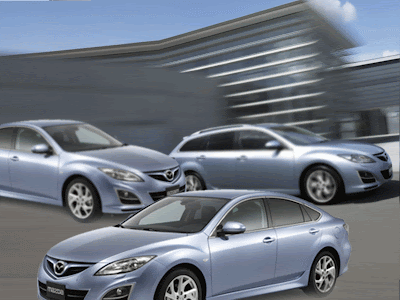
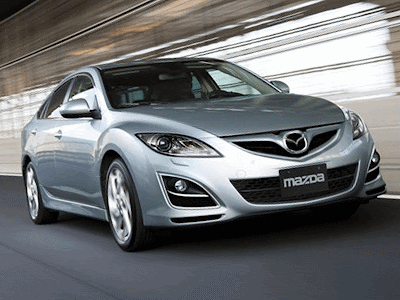
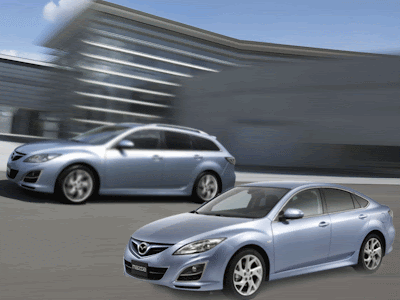
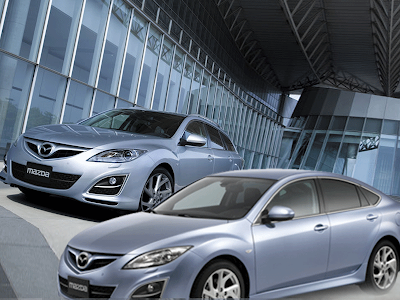
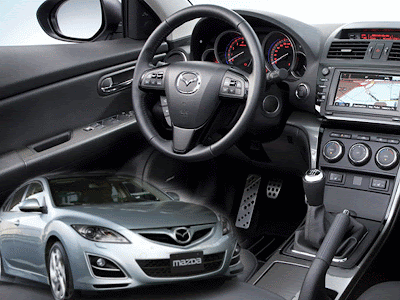
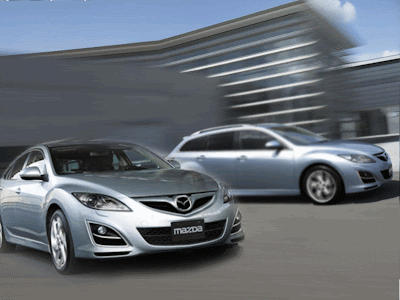
2011 Mazda 6 Facelift Car Photos

2011 Mazda 6 Facelift Picture2011 Mazda 6 Facelift Picture

2011 Mazda 6 Facelift Side View2011 Mazda 6 Facelift Side View

2011 Mazda 6 Facelift Exotic Car2011 Mazda 6 Facelift Exotic Car

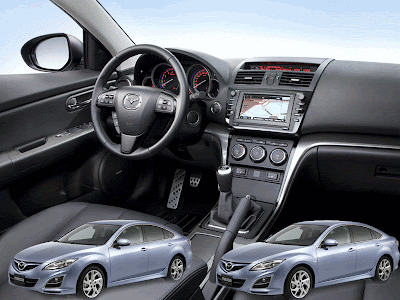
2011 Mazda 6 Facelift Interior 2011 Mazda 6 Facelift Interior

Saturday, April 10, 2010

2011 Mazda5 Pictures And Image

2011 Mazda5 Front Angle View2011 Mazda5 Image Front Angle View

2011 Mazda5 Picture2011 Mazda5 Picture

2011 Mazda5 View Interior2011 Mazda5 View Interior

Tuesday, March 30, 2010

2010 Mazda CX-7 Diesel

2010 Mazda CX-7 Diesel Front View2010 Mazda CX-7 Diesel Front View

2010 Mazda CX-7 Diesel Car Wallpaper2010 Mazda CX-7 Diesel Car Wallpaper

2010 Mazda CX-7 Diesel Gauges2010 Mazda CX-7 Diesel Gauges

2010 Mazda CX-7 Diesel Side View2010 Mazda CX-7 Diesel Side View

2010 Mazda CX-7 Diesel Car Interior2010 Mazda CX-7 Diesel Car Interior

2010 Mazda CX-7 Diesel First Drive2010 Mazda CX-7 Diesel First Drive

2010 Mazda CX-7 Diesel Front Seats2010 Mazda CX-7 Diesel Front Seats

2010 Mazda CX-7 Diesel Rear View2010 Mazda CX-7 Diesel Rear View

2010 Mazda CX-7 Diesel Cargo Area Place2010 Mazda CX-7 Diesel Cargo Area Place

2010 Mazda CX-7 Diesel Engine2010 Mazda CX-7 Diesel Engine

Mazda MX5 Matte Black Special Edition Photos

Mazda MX5 Matte Black Special Edition Front ViewMazda MX5 Matte Black Special Edition Front View

Mazda MX5 Matte Black Special Edition WheelsMazda MX5 Matte Black Special Edition Wheels

Mazda MX5 Matte Black Special Edition Car WallpaperMazda MX5 Matte Black Special Edition Car Wallpaper

Mazda MX5 Matte Black Special Edition Sporty CarMazda MX5 Matte Black Special Edition Sporty Car

Mazda MX5 Matte Black Special Edition PhotoMazda MX5 Matte Black Special Edition Photo

Mazda MX5 Matte Black Special Edition Rear Side ViewMazda MX5 Matte Black Special Edition Rear Side View

Mazda MX5 Matte Black Special Edition PictureMazda MX5 Matte Black Special Edition Picture

Tuesday, March 9, 2010

2011 Mazda Sports Car Mazda6 Facelift

Mazda has released the first 2011 Mazda6 facelift images and details and announced that the new version will be premiered at the Geneva auto show in March. As far as the exterior design goes, the 2011 Mazda6 facelift features new headlights and rear light clusters. This new, upgraded version enhances the strengths of its predecessor, retaining its fun-to-drive feeling and excellent fuel efficiency; while improving refinement, cabin ambience, environmental compatibility and safety performance. 
2011 Mazda Sports Car Mazda6 Facelift
The 2011 Mazda6 facelift also comes with new chassis settings and several new active safety features – like a new pivoting adaptive front lighting system and hill-launch assist – that together make the Mazda6 facelift one of the safest and easiest-to-drive cars in its segment.
2011 Mazda Sports Car Mazda6 Facelift
The Mazda Mazda 6 design concept is "bold & exquisite." The updated model carries over the solid front face of its predecessor, and retains the beauty, strength and tension conveyed through its simple contours. With enhancements for a stronger expression of dynamism and sportiness, the latest facelifted Mazda 6 expresses a more premium identity. 
2011 Mazda Sports Car Mazda6 Facelift
Six engines will be available, including a powerful new 2.0-litre DISI petrol that uses less fuel and produces fewer emissions than the 2.0-litre engine it replaces. Its five-speed automatic transmission was adapted especially for this new petrol engine to deliver an optimal combination of acceleration and fuel economy.
2011 Mazda Sports Car Mazda6 Facelift
The 2011 Mazda6 facelift also offers updated versions of the MZR 1.8 and 2.5-litre engines while the MZR-CD 2.2-litre turbo diesel unit is offered in three power levels, from 129 to 180 PS, all of them sporty, with improved fuel-efficiency and lower CO2 emissions. 
2011 Mazda Sports Car Mazda6 Facelift
The 2011 Mazda6 facelift price will be announced later in the spring when the new version will go on sale across Europe. It is one of three premieres that will be unveiled at Mazda’s press conference to be held at the Mazda stand in Hall 5, on 2 March.

2011 Mazda Sports Car Mazda6 Facelift

Mazda has released the first 2011 Mazda6 facelift images and details and announced that the new version will be premiered at the Geneva auto show in March. As far as the exterior design goes, the 2011 Mazda6 facelift features new headlights and rear light clusters. This new, upgraded version enhances the strengths of its predecessor, retaining its fun-to-drive feeling and excellent fuel efficiency; while improving refinement, cabin ambience, environmental compatibility and safety performance. 
2011 Mazda Sports Car Mazda6 Facelift
The 2011 Mazda6 facelift also comes with new chassis settings and several new active safety features – like a new pivoting adaptive front lighting system and hill-launch assist – that together make the Mazda6 facelift one of the safest and easiest-to-drive cars in its segment.
2011 Mazda Sports Car Mazda6 Facelift
The Mazda Mazda 6 design concept is "bold & exquisite." The updated model carries over the solid front face of its predecessor, and retains the beauty, strength and tension conveyed through its simple contours. With enhancements for a stronger expression of dynamism and sportiness, the latest facelifted Mazda 6 expresses a more premium identity. 
2011 Mazda Sports Car Mazda6 Facelift
Six engines will be available, including a powerful new 2.0-litre DISI petrol that uses less fuel and produces fewer emissions than the 2.0-litre engine it replaces. Its five-speed automatic transmission was adapted especially for this new petrol engine to deliver an optimal combination of acceleration and fuel economy.
2011 Mazda Sports Car Mazda6 Facelift
The 2011 Mazda6 facelift also offers updated versions of the MZR 1.8 and 2.5-litre engines while the MZR-CD 2.2-litre turbo diesel unit is offered in three power levels, from 129 to 180 PS, all of them sporty, with improved fuel-efficiency and lower CO2 emissions. 
2011 Mazda Sports Car Mazda6 Facelift
The 2011 Mazda6 facelift price will be announced later in the spring when the new version will go on sale across Europe. It is one of three premieres that will be unveiled at Mazda’s press conference to be held at the Mazda stand in Hall 5, on 2 March.

Tuesday, February 23, 2010

Mazda 3

Mazda 3


The Exterior design - expressive and emotional styling
A distinctive new front fascia is formed by the 5-point grille and openings at the front corners. These design cues combine with the sculpted shape of the hood and the bold, expressive lines that connect the hood to the front pillars. All the lines seem to flow into the center just below the 5-point grille, which creates a stronger expression of power and dynamism. From the side, the front fender line smoothly morphs into the beltline, clearly identifying the vehicle as a Mazda and communicating dynamism. The line of the side sill curves up and seems to connect with the rear spoiler to emphasize the vehicle's compact size and express its agility. In order to make the surface more expressive, Mazda designers slightly elaborated the depth of the hood edge, front fenders and the three-dimensional shape of the protruding body sides, carefully crafting curves that subtly reflect changes in natural light.

The rear view boasts a sporty design with wide stance. The strongest features are the protruding shoulders and emphasized center-focus design. This concept was carried over from the first generation Mazda 3 and made bolder to represent expressiveness. All the lines of the rear view are designed to concentrate on the brand symbol in the center. The impressive C-pillar design was also inherited from the first-generation Mazda 3 and made more prominent. This was made possible by Mazda's expertise in stamping technology.


The Interior design : sophisticated, sporty, and high quality
The inside of Mazda 3 is a sporty yet highly refined cabin. The dashboard sweeps out from the center toward both sides with dynamic flair as though it is flexing powerful muscles. The large center display and controls are laid out around the driver to deliver just the right feeling of snugness. The angle of the center panel was adjusted after careful analysis of the driver's hand movement, producing a more stylish and dynamic design. A soft, wood grained surface with minimized parting lines on the top of the dashboard enhances the interior quality. The new interactive lighting control enhances the driver's connection with the vehicle.


The Powertrains for all driving experiences
The powertrains combine Mazda's typical Zoom-Zoom driving experience with excellent environmental performance to provide exhilarating driving. They transmit just the right amount of G force that perfectly matches the vehicle's actual acceleration. This provides the driver with a more refined experience of oneness with the car. The new engine line up has been tailored for European customers and now includes the newly developed MZR-CD 2.2-litre turbo diesel engine, carried over from the all-new Mazda 6, in addition to the MZR-1.6-litre and 2.0-litre gasoline engines and the MZ-CD 1.6-litre turbo diesel. It is a high-performance clean diesel engine with top class output, fuel economy and quietness. The MZR-CD 2.2-litre turbo diesel engine will be offered in two variants: a high power version with a maximum torque of 400 Nm/1,800-3,000 rpm and a maximum output of 136 kW (185 PS)/3500 rpm, and a standard power version with a maximum torque of 360 Nm/1,800-2,600 rpm and a maximum output of 110 kW (150 PS)/3500 rpm. Both versions have outstanding clean emissions performance, comply with the Euro Stage 5 regulations and feature a Mazda developed unique Diesel Particulate Filter (DPF) technology for more efficient regeneration. Fuel economy is also greatly improved by 7 to 10 percent compared to the MZR-CD 2.0-litre engine equipped in the existing model, attaining 5.4 l/100 km for the standard power version and 5.6 l/100 km for the high power version.

The MZR 2.0-litre petrol engine underfloor catalyst is the world's first vehicle catalyst to be constructed with single nanotechnology, which controls even finer materials structures than nanotechnology. It is used to embed individual particles of precious metals, which are less than 5 nanometers in diameter, into the catalyst base material. This new development enables Mazda to reduce the amount of expensive precious metals such as platinum and palladium by 70 to 90 percent without impairing catalyst performance. The catalyst is an important part of Mazda's efforts to reduce reliance on limited resources.

Power steering, suspension and brake systems
To deliver just the right balance between fuel economy, light steering-wheel operation and a feeling of stability, all configurations of the all-new Madza3 are equipped with the Electro-Hydraulic Power Assist Steering system (EHPAS) that has earned high acclaim on the first generation Mazda 3. The suspension is based on the first generation Mazda 3 system, and has been enhanced to ensure even nimbler response to steering wheel operation, and also to improve roll control and maintain a flatter ride by strengthening the suspension damping. In the brake system, the vacuum booster has been tuned and the feeling of initial brake application has been optimized. The overall result is outstanding response and reassuring linearity under all braking conditions.


The Highly rigid body
The basic development concept for the body shell of the all-new Mazda 3 was to improve the overall balance of the body's rigidity and ensure it firmly absorbs the reaction force of the dampers. To this end, particular attention went to reinforcing the area around the front and rear suspension mounts and the joint sections in each corner, which are subject to greater stress. Structural adhesive was used to strengthen the joints for the front and rear suspension towers, and spot welding was added to reinforce the joints of the door openings. The result is a substantial improvement in rigidity and body hysteresis (the degree of car body deformation due to repeated applications of torsional load).

Class-leading aerodynamics
The drag coefficient for the European specification 5-door hatchback and 4-door sedan are respectively 0.30 and 0.28, amongst of the bests in the segment. These measures helped the engineers attain top-class levels for wind noise reduction, high speed stability and fuel economy.

Cabin environment - sense of oneness between car and driver
Aboard the all-new Mazda 3 is a new Human Machine Interface that contributes to the sense of oneness between the car and driver. The cabin interior is designed to allow the driver to concentrate on driving and also appreciate the level of quality in both design and the materials used.

A sporty cockpit that improves functional beauty
The new "zone layout" approach focuses on improving visibility and more intuitive controls which provide "a sense of the car and driver as one" and "a reassuring sense of confidence that frees the driver to concentrate on driving." First, the Mazda 3 development team integrated the information display and positioned it towards the front in the optimal "zone." This placed the information necessary while driving where it can be seen with the least amount of eye movement. Next, the engineers placed all the controls and switches within a single "zone" closer to the driver's hands. Designing the cockpit with controls and information display in separate zones frees the driver to concentrate on driving.

The Multi information display (MID)
Based on the concept of the zone layout, Mazda developed the Multi Information Display (MID). It clearly shows information on all the equipment needed while driving, such as the trip computer, audio system and compact GPS system (optional), which can be operated easily by switches mounted on the steering wheel.

Seats that fit better, provide greater support and are more functional
The raised sides on the front of the seat cushions were made 20mm larger than on the first generation Mazda 3 to increase the leg support for a better fit. The seat backs were also extended by 35mm, which better supports the occupant's posture. Seat position adjustment controls were also evolved. The new power seat has a 3-position memory function. Upon approach to the car, the left-front seat automatically adjusts to the settings chosen by up to 3 different drivers by recognizing the code of the key fob. High-grade models feature standard sports seats.

Substantially reduced road and wind noise
Many improvements were made to structural rigidity and powertrain NVH performance to provide a quieter, more pleasant ride, including the reduction of high frequency booming noise sometimes heard when decelerating while further evolving a sporty engine note. Increasing the rigidity of components and joints also helped to deliver a quieter ride that rates among the class leaders. The sound pressure level of road noise was curtailed by 6 to 11 percent over the previous model, and wind noise was reduced by approximately 6 percent, to 59.0 dB at 100 km/h with a 5 m/s crosswind, placing the all-new Mazda 3 among the quietest in the class.

The Safety
Mazda focused on enhancing active safety equipment that supports the recognition and avoidance of hazards. Specifically, the cutting edge active safety technologies featured on the all-new Mazda 3 :
ABS, Electronic Brake Force Distribution (EBD), Dynamic Stability Control (DSC) and Emergency Stop Signaling system(ESS) as standard equipments, and bi-xenon headlights with a pivoting adaptive front lighting system (option).
New features include the Rear Vehicle Monitoring system (RVM), Tyre Pressure Monitoring System (TPMS) and Heated Wind Shield (option). The new model's passive safety systems are comprehensive and include Mazda proprietary highly-rigid and safe vehicle body technology, the Mazda Advanced Impact-energy Distribution and Absorption System, as well as front seat active headrests and a complement of six airbags, placing the all-new Mazda 3 at the level of the top marks in collision safety testing around the world.

Mazda Kiyora Concept

Mazda Kiyora Concept


The Mazda Kiyora gives an indication where Mazda could go with a small, eco-friendly city car in the near future. It is highly fuel efficient, with a very small CO 2 footprint, delivering Zoom-Zoom driving fun and high levels of safety. The car achieves this by taking Mazda's acclaimed lightweight strategy to a new level by employing an extremely rigid and lightweight carbon-fibre body structure beneath a small, aerodynamic outer skin and a spirited, small-displacement 1.3-liter direct-injection engine. Mazda Kiyora also features Mazda's unique Smart Idle Stop System (SISS) and a newly developed six- speed automatic transmission with direct feel and fuel efficiency similar to that of a manual. With these technologies, the Mazda Kiyora concept would produce CO 2 emission of under 90g/km.

Themes for the Mazda Kiyora concept include cleanliness, health and safety. These key aspects are essential for young city dwellers as well as any compact car in the current global environment. The concept was based on Mazda's sustainable technology vision, which aims to ensure customers can continue to enjoy a Zoom-Zoom experience in the future. Water was also selected as a theme for this concept, due to its association with the aspects mentioned above, and the car was named Kiyora (meaning 'clean and pure' in Japanese) to reflect this. It features next-generation technologies clothed in a friendly and cool design that is as functional as it is beautiful. This is the first concept to express Nagare 'low' in the patterns and colours of water.

Defining the Concept, "Urban Hub" - Advanced Product Strategy
Mazda Kiyora is a redefinition of the small coupe and is dedicated to embody the same fun-to-drive nature as every other Mazda vehicle, combined with innovative ideas that minimize its impact on the environment. This concept is the translation of Mazda's Sustainable Zoom-Zoom philosophy into a lifestyle vehicle for progressive urbanites.

Kiyora is even smaller than the new Mazda 2. Reducing vehicle weight is a key concept that is crucial to achieve the goals set out in the Sustainable Zoom-Zoom plan. Kiyora takes Mazda's 'gram strategy' — that has been used previously to produce new vehicles, all of them lighter and more fuel eficient than their predecessors — to the next level. It should also be flexible, a kind of 'urban HUB' that would allow you to go to university during the day, go shopping in the early evening, and take three friends clubbing at night before driving home, thanks to its lexible interior that can be used as a two-seater with boot, or as a 2+2 seating arrangement. The car should have a next-generation cockpit and be fun to use on a daily basis. And it should be safe and environmentally friendly.

The Zoom-Zoom Experience and Environmental Performance Mazda Kiyora supports the active lifestyles of young people with its agility, cleanliness, and excellent economic performance. Mazda's next-generation 1.3-litre DISI petrol engine is an evolution of technologies used for the 2.3-liter DISI petrol engine that currently powers Mazda's sports crossover SUV, the Mazda CX-7. Improved direct- injection technology and newly designed combustion chambers enable more precise ignition control.
The engine's efficiency is increased by a combination of advanced dual sequential-valvetiming (S-VT), variable-valve timing and lift mechanism, and optimal valve control. The engine is spirited as well as clean and efficient and, in combination with a compact and lightweight six-speed automatic transmission with manual shift control, it would make Mazda Kiyora powerful and cultivated, even at low engine speeds. In stop and go urban traffic conditions, Mazda's newly developed Smart Idle Stop System (SISS) would save fuel by automatically shutting down the engine when the vehicle is stationary, and achieves a quick and quiet restart for stress free driving. The system injects a small amount of fuel directly into the engine's cylinders and ignites it to generate downward piston force which, with the aid of an electric motor, rapidly returns the engine to idle speed. Emissions would be among the lowest thanks to a new catalyst that more effectively removes harmful exhaust materials by employing single-nanotechnology to control catalyst particles that are smaller even than those controlled by conventional nanotechnology. Combined with reduced weight and improved aerodynamics, these insightful technologies would result in CO 2 emissions of 90g/km or less.


Exterior - Fusing Form with Function
The Mazda Kiyora concept car is formed in the shape of a water droplet on its side, as are its two side windows. Its diminutive size and low roofline give it a small front cross-section. This is combined with an elaborate underbody that controls wind swirl, a rear roof spoiler, and specially sculptured body lines for a highly aerodynamic form with a coefficient of drag that is over 10 percent lower that of the current Mazda2. This outstanding fusion of engineering and the Nagare design was a key target.
About 10 cm shorter than the new Mazda2 sub-compact, Kiyora is also an environmentally friendly city car that is cute and agile, and invites you to climb in for a ride. It uses a soft design language and lowing lines, while retaining an overall style that is really expressive and sporty. Here is the expressive five-point grille first used on the Mazda Sassou concept three years ago - backlit when the car is on with soft, red lighting - but now further developed with Nagare low lines that are carved and more three-dimensional. They are formed to guide air into the interior of the car without the use of fans, which saves weight. Its silhouette features character lines that are sleek and smooth, and move upwards and rearwards, fusing into the rear spoiler. Combine it all with 18-inch alloys and extremely small overhangs, and you have a truly sporty look in a small package.

Though small, Mazda Kiyora has a rear boot big enough to carry a large suitcase, a briefcase and a notebook. It is accessible via a liftgate that opens very high (with a low load floor level) for easy loading and unloading, and it's flexible. When the rear seats are not in use, you can push your luggage forward and stow even more, while the strong yet flexible seat material stretched over the seats holds the luggage in place. This system also has the advantage that it hides whatever is stored in the boot from prying eyes outside the car.
The roof of the new Mazda Kiyora is another example of how Mazda designers were able to combine functionality and design aesthetics. It is transparent, for an open-air feeling on the inside, and has photovoltaic solar cells which provide electricity for the car's interior systems.
The doors and side windows of Mazda Kiyora are fused into a single unit and function as both. These 'windoors' are made of plastic, which provides the same transparency and refraction properties as glass, and the strength of a thin-panel door, but with far less weight. They are also easy to use and practical. Touching the surface of the front tip of the door activates a sensor, which opens the doors up and away from the car, a plus when parking in tight city spaces. They also allow a view into the interior when the doors are closed. But looking into Mazda Kiyora is more than just looking through glass.
The design of the wheels also supports the water theme. Its front spokes are convex and shaped like the blades of a boat propeller, while the concave back spokes are joined to the wheel rim and have a reinforcement that seems to grow out of the spoke itself. Kept very smooth, the wheels of Mazda Kiyora give a twirling, twisting surface articulation.


Interior Design - Visualised 'Nagare' Design and an Expression of Lightness
The interior shapes not only provide aesthetic motifs, they also function to stiffen the passenger compartment with minimal weight. Mazda's strategy of shedding excess grams wherever possible in its production cars was taken to a new level in Mazda Kiyora. The visible body structure is a real structural element of the car - stiff and crash-resistant. It is indicative of Mazda's approach to conduct a thorough structural analysis to solve complex issues such as safety and rigidity requirements instead of simply replacing materials with more expensive ones. The rear seats that are integrated into the body framework are also examples of this approach. Lightweight materials such as aluminium and a special resin foam, which is under development at Mazda, would be used not only for interior parts such as the instrument panel, but also for the bonnet, tailgate and sections of the chassis. Their effective usage contributes to improving the yaw moment of inertia and reducing the unsprung mass, and leads to superb handling.

The Mazda Kiyora concept has interior shapes that express Nagare 'low' by looking as though they are floating in a current of sea water that is moving from front to back. The instrument panel starts at a single point and lows around the driver and to the right of the front passenger as if it were several blades of sea grass growing out of a rock underwater. The front seats seem to float above the floor, and the arms of body structure twist like sea weed at the sides and top of the cabin. As well as being an integral design element, the door structure also functions as a side member and, in combination with the side sills, would effectively protect occupants in the event of a side impact.

New Liquid-Skin Display IP Concept
This display would be a simple yet very practical type of instrument panel that uses advanced touch-screen technology with tactile feedback. Using liquid-skin display technology, it would mimic the rippling that water makes when you touch it with your finger. When the car is off, the IP looks like ice, frozen and hard. When the car is switched on, the display appears to turn into water. Information icons would appear and float downwards to pre-programmed positions in front of the driver. The driver would be able to move the icons around with his finger and could even organise them however he wished. He could lip through menus, select settings for temperature, and even send an email.
From the touch-screen display, you could also control a hard-disk drive with advanced sensors that would provide environmental information like how much fuel you used and how many grams of CO 2 you released into the atmosphere on a particular day. It could also calculate how many toxins the car filtered out of the air and water during the same period.

Considerations for the Cabin Environment
The Mazda Kiyora concept would be able to filter out toxins from the outside air and use it inside the car. The right side of the dashboard consists of a large, single piece of thick activated carbon, which is a natural resource that has been used for centuries in Asia as a purifying material. The above-mentioned Nagare low lines at the front of the car guide outside air into the car and through this charcoal, which filters out and captures toxins better than most filter systems, without the need for an electric fan or inorganic materials. Taking advantage of rain as a natural resource the roof of the Mazda Kiyora channels rainwater firstly through an activated carbon filter and then into a specially commissioned drinks bottle designed for Mazda by LIFESAVER® systems. The LIFESAVER® bottle citi™ is located between the front seats for easy access, and uses state of the art ultra filtration hollow fibre membranes. With a pore size of 15 nano-meters these membranes remove microbiological contamination including bacteria and viruses without the aid of chemicals, delivering safe fresh drinking water to the user any time.

The bottle is removable so can be taken out of the car and used to gather water from other natural sources such as rivers, lakes and streams.
Colours and Materials - A Triumph of Material Engineering Mazda Motor Europe's Colours + Materials team has distinguished itself in the development of new kinds of materials for its concepts. In Sassou, it was translucent plastic treated in a way to match the body colour and to hide light effects, and in Hakaze it was the brilliant use of surface textures that mimic the feel of natural materials. With the Mazda Kiyora, the colours and materials team faced its greatest challenge yet - to express the theme of 'pure water' in visible and touchable ways.

The exterior of the Mazda Kiyora is blue-green and has transparent, polycarbonate doors, chosen to underscore the purity of water. On the inside you can see forms - like the wavy side member of the body structure - that look like lowing sea grass. These were given a colour scheme that, when seen through the doors from outside the car, makes it seem as though you are looking into water.
The interior is a masterpiece of materials engineering. The body shell is visible, like an inner skeleton, and supports the water theme with its wavy, lowing shapes, while functioning as a true body structure. And the interior has a colour scheme that makes the front seats seem to float above a floor that looks like frozen water. For the instrument panel and door inners, soft coatings and light metallic effects are employed to enhance this impression.

The rear seats are one of the concept's most interesting features and a perfect example of how to combine material and design to express the theme of water, while saving weight and losing nothing in functionality. They are made of only two components: a seat skeleton that is part of the body structure at the back of the cabin, and a flexible and robust textile stretched over this. This textile allows a person to sit down into the seat and acts as a irm surface to sit on like a lawn chair, and then to spring back to its original shape when the person leaves the car - effectively hiding the seats. This 'hidden seat' is designed for short trips in town, and is far lighter than traditional car seats.

The rear seats also work in conjunction with the floor to contribute colour-wise to the overall theme of pure, watery depths. Both the seats and the floor are made of the same materials, but treated differently to maximise their functionality. Two-dimensional printing was employed for the colours and sea grass graphics on the seats, and a unique, three-dimensional (3D) casting process was used for the floor surfaces. The 3D casting process was inspired by the PU micro-injection printing process used on textiles for sportswear. This allowed the team to give the floor surface the durability and abrasion strength needed to function as a real floor, and to create the image of deep and layered surface to express the image of water and ice.
Technical Specifications
* Body type: Three-door hatchback
* Dimensions
o Overall length: 3,770 mm
o Overall width: 1,685 mm
o Overall height: 1,350 mm
o Wheelbase: 2,495 mm
* Seating: 2 + 2
* Engine Type: Next generation MZR 1.3-litre DISI petrol with smart idle stop system
* Transmission: Next-generation 6-speed AT with manual shift
* Suspension
o Front: MacPherson strut
o Rear: Torsion beam

Mazda MX-5

Mazda MX-5


The Exterior Design: A Fusion of New Mazda Elements and an Unmistakable MX-5 Look
The front grille has been enlarged and changed from an oval shape to the five-point grille that forms part of the well-known Mazda family face. Combined with tautly styled headlights and lowing fog- lamp bezels, the new grille creates a reined and athletic expression.
The five points of the grille are slightly rounded the new shape of the front bumper, with corners that extend downwards, enhances the dynamic look and improves the aerodynamics.
The rear bumper has a new design that makes the rear look wider, sportier, and more integrated into the body. The rear combination lamps inherit the traditional MX-5 elliptical motif, and protrude further outboard for greater aerodynamic efficiency.

The Roadster Coupe's more Upscale Identity
The Mazda MX-5 Roadster Coupe, which features a groundbreaking powered roof system, also incorporates several design changes that further emphasize its more upscale identity and distinguish it from the soft-top version.
* Front grille: Whereas the soft-top version has a in-type grille, the Roadster Coupe has a mesh grille that is framed by a chrome ring.
* Headlamp inner bezels: The headlamp inner bezels are painted silver on the soft-top version, but have a chrome finish on the Roadster Coupe.
* Fog-lamp inner bezels: The fog lamp inner bezels are black on the soft-top version, but are painted silver on the Roadster Coupe.
* Outer door handles: The outer door handles are body-coloured on the soft-top version, but have a chrome finish on the Roadster Coupe.
* High-mounted stop lamp: The high-mounted stop lamp has a red lens on the soft-top version, but a clear lens on the Roadster Coupe.


The New Wheel Designs
The MX-5 is available with 16-inch and 17-inch aluminium wheels. The 16-inch wheels have five sets of twin spokes for a lightweight look. The 17-inch wheels have 10 twisted spokes for a stronger impression of power and dynamism.

The Interior Design: Higher Than Ever Quality and Driver- Friendliness
The interior design delivers the Mazda MX-5's traditional combination of comfortable snugness below shoulder level and openness above shoulder level. It also reflects customer feedback in the form of enhanced quality and driver-friendly features.
The decorative surfaces on the instrument panel have been changed from glossy piano black to dark silver, which has a subtler, higher- quality look befitting a sports car. The meters have new graphics for higher legibility. The climate-control dials on the centre stack have each been given a silver-coloured ring for a higher-quality look. A protrusion has been eliminated from the outer surface of each door pocket to create more leg space. And the door and centre-console armrests have each been given a soft pad for a better feel.
Recaro seats designed exclusively for the MX-5 are available in certain regions. They are upholstered in leather and perforated Alcantara for a sporty look, and they combine excellent support with easy ingress and egress.

Evolved Jinba Ittai for Enhanced Fun-To-Drive
The Jinba Ittai feeling on which Mazda has always focused with the Mazda MX-5 defines the kind of spontaneous car-and-driver interaction that anyone can experience whether they're driving the MX-5 in town, on twisty roads, or on an open highway. With the latest facelift, Mazda engineers evolved the attributes in the "driving", "cornering", "braking", and "listening" categories in the fishbone chart to realize performance that lets drivers enjoy the feeling of oneness with the car to an even greater degree.

A 500 rpm Higher Rev Limit Maximizes Engine Potential for Greater Enjoyment
The powertrain has been enhanced to enable the driver to enjoy the full potential of the engine's performance (a key "fun to drive" aspect of the MX-5). Specifically, the speed at which the engine delivers maximum power has been raised from 6,700 rpm to 7,000 rpm (2.0-litre M/T version) and the rev limit has been raised from 7,000 rpm to 7,500 rpm (all 2.0-litre versions). Without these enhancements, the engine feels smooth and linear right up to the rev limit, even with the throttle wide open. With them, however, the driver can really experience the sensation of extracting every single horsepower out of the engine (the enhancements described here apply to the 2.0-litre grades with a manual transmission). The crucial 500 rpm increase in the rev limit is enabled by greater precision in the engine, namely: a forged crankshaft (this ensures the required rigidity at high engine speeds), fully floating pistons and newly designed valve springs.

A Sportier Engine Sound that Responds More Crisply to Accelerator Inputs
The engine sound (a key element in the "listening" category of the MX-5 fishbone chart) is a big part of the sports car experience. With the latest facelift, Mazda engineers made the Mazda MX-5 engine sound even better without causing aural discomfort for people outside the car. Notably, they increased the rigidity of the plastic surge tank in the intake manifold. The optimized surge tank combines with the new forged crankshaft to realize a clearer engine sound throughout the rev range. In vehicles with the six-speed manual transmission, the engineers also adopted a newly developed device called an Induction Sound Enhancer (ISE). This amplifies the pulses that occur when an accelerator input opens the throttle valve to increase air low into the engine, thereby delivering a more exciting sound to the cockpit. The intake sound created by the ISE feels synchronized with the driver's accelerator inputs, so the driver enjoys a crisp, thrilling engine sound even when using the accelerator pedal gently to adjust the revs for a downshift.

The Newly Evolved and Reined Transmissions
With the six-speed manual transmission, the meshing surfaces of the 1st-4th triple-cone synchronizers are now carbon coated, and the 3rd-4th synchronizer diameter has been increased. These improvements enable smoother shifts up to the engine's heightened rev limit of 7,500 rpm.
A 6-speed Activematic automatic transmission that's newly available with the MX-5 for Europe incorporates two new control technologies. One is Direct Activematic (DAM), which allows the driver to quickly change gears using paddles on the steering wheel while still driving in the "D" range. It was developed to enable quick downshifts for three common situations: decelerating using engine braking on a downhill road; accelerating after decelerating into a corner; and overtaking another vehicle. (The driver does not need to select the "M" range before shifting down.) Since Direct Activematic enables engine braking and acceleration more quickly and easily, it makes driving easier and more fun. The other new technology is Active Adaptive Shift (AAS), by means of which the transmission control system evaluates the driving situation from factors such as the road's gradient and twistiness and the accelerator and brake inputs. When the system recognizes enthusiastic driving, it actively promotes upshifts and downshifts to realize a linear and sporty response that matches the driver's intentions.

An Athletic Design that Heightens Aerodynamic Performance
To improve handling stability, quietness, and high-speed fuel economy, the MX-5 development team drew on Mazda's expertise in incorporating aerodynamic improvements into styling that's faithful to a design theme. The main aerodynamic improvements are as follows:
* air guides that protrude downward from the left and right corners of the front bumper
* specification vehicles, except some specific markets)
* protruding rear combination lamps
* wider front tyre deflectors
The Quieter Ride in the Roadster Coupe
Given the Roadster Coupe's more upscale positioning, the development team produced a quieter ride by reducing wheel resonance and adding damping and sound-insulating materials, such as urethane filling in the front suspension crossmember and damping material in the front part of the roof. Thanks to these improvements, road noise in the cockpit on a coarse road surface with the roof closed is 2.1dB lower than before. Quietness is further promoted in the Roadster Coupe and soft-top version by stiffer door modules and by newly added reinforcements on the No. 2 crossmember.

The Enhanced Environmental Performance for Greater Enjoyment
The Mazda regards efforts to reduce fuel economy and exhaust emissions not only as a vital way to protect the environment but also as a way to make sports cars more fun to drive. With the latest MX-5 facelift, Mazda engineers addressed fuel economy by reducing the rolling resistance of the tyres, reducing engine friction, and revising the transmission gear ratios. Lower exhaust emissions were achieved through upgraded precious metals in the catalytic converter. The Mazda MX-5's improved emission performance complies with Japan's SU-LEV standard, the European Union's Stage 4 standard, and the United States' ULEV2 standard.