

 Aston Martin Cygnet Interior
Showing posts with label Aston Martin. Show all posts
Showing posts with label Aston Martin. Show all posts
Saturday, June 5, 2010

Tuesday, June 1, 2010
Aston Martin DB4 Classic Cars

The company was founded in 1914 by Lionel Martin and Robert Bamford. The company name was derived from the fact that Lionel Martin raced specials at the Aston Clinton hill climb. Their first car was built in 1915 and was referred to as the Coal Scuttle. Three more prototype cars were built, chassis number A3 was the third Aston Martin ever built and is the oldest in existence with a 1.5 litre 11 hp four cylinder side valve. In 1923 it was able to lap Brooklands at 84.5 mph.
 Two Grand Prix Team cars (TT1 and TT2) were built for Count Zborowski to compete in the 1922 Isle of Man TT (although they were not ready in time) Originally featuring a engine with twin camshafts and 16 valves, the cars were then fitted with the Benson Twin Cam engines. This was designed by The Hon. John Benson as a new power unit for the cars just before Bamford and Martin called in the receivers in 1925. A total of approx 61 cars were built during this era, insufficient to save the company.
Featured elegant coachwork designed by Touring of Milan, Italy. The handmade, aluminum bodywork panels were mounted on a steel tube frame, using the Superleggera (meaning: super light) method of construction. All round disc brakes fitted, made first by Dunlop and later on by Girling. There were five series of the DB4, each series introduced changes and improvements to the original series one cars. Early cars have a mesh grille and simpler bumper design. Later cars are longer and consequently heavier than early cars, some late series five cars had DB5 style headlamp covers.
All DB4s were powered by a new six cylinder, all aluminum, 3670cc engine designed by Tadek Mereck, developing around 240bhp. The DB4 offered excellent performance for the time, 140mph top speed and 0-60 in 8.5 seconds. Overdrive transmission on most cars, the gearbox was produced by Astons' owner, David Brown. A Vantage engine was also available, offering even higher power outputs.
Article Source: http://EzineArticles.com/?expert=John_Jarmola
Saturday, May 15, 2010
Aston Martin DBS 2008


Thursday, May 6, 2010
2010 Aston Martin Sports Car Rapide Nurburgring Race Car

The Aston Martin Rapide Nurburgring race car has been unveiled today and the company says it will make its debut in the 24-Hour event that will take place on 15/16 May 2010. Previously, Aston Martin has competed in the Nurburgring 24-Hour race with the V8 Vantage and the V12 Vantage. for this year, the British brand goes four-door.

Aston Martin Rapide
For all those who thought Aston Martin had somehow gone soft by offering a four-door saloon, the famed British marque plans to prove the new Rapide is no slouch by entering it in the 38th ADAC Nurburgring 24-hour race on May 15-16. Piloting the vehicle win the grueling race will be none other than Aston Martin’s CEO Dr. Ulrich Bez, who at age 66 can still give the young guns a run for their money. Aston, with Bez at the wheel, has won top honors in the race’s production-based SP8 category for the past two years with versions of the Vantage coupe.

The Aston Martin Rapide Nurburgring is extremely close to the production car. The only differences between the Aston Martin Rapide Nurburgring and the production model include the removal of interior trim to save weight, re-tuned suspension and slick tires.

Aston Martin Rapide to contest gruelling Nürburgring 24-hour Race
Gaydon, Warwickshire 6 April 2010. Aston Martin will return to the starting grid of the legendary Nordschleife circuit for the fifth consecutive year at the 38th ADAC Nürburgring 24-hour race on 15/16 May 2010 with the marque's new four-door sports car; the Rapide.
Further underlining the sporting credentials of Aston Martin's latest model, the Rapide will compete in the demanding 24-hour race - as has been the case with other recent Aston Martin road cars, the V8 Vantage and V12 Vantage. The Rapide will compete in near-standard specification apart from mandatory changes required to compete in this most demanding of endurance races and will be driven by a team of engineers from the company's Gaydon headquarters in Warwickshire, England.


Further details on the V12 Vantage and the full driver line-ups for both Aston Martin entries plus details on a number of customer teams competing in the race will follow in the coming weeks.
The 38th ADAC Nürburgring 24 hour race will take place on 15/16 May 2010.
2010 Aston Martin Sports Car Rapide Nurburgring Race Car
The Aston Martin Rapide Nurburgring race car has been unveiled today and the company says it will make its debut in the 24-Hour event that will take place on 15/16 May 2010. Previously, Aston Martin has competed in the Nurburgring 24-Hour race with the V8 Vantage and the V12 Vantage. for this year, the British brand goes four-door.
Aston Martin Rapide
For all those who thought Aston Martin had somehow gone soft by offering a four-door saloon, the famed British marque plans to prove the new Rapide is no slouch by entering it in the 38th ADAC Nurburgring 24-hour race on May 15-16. Piloting the vehicle win the grueling race will be none other than Aston Martin’s CEO Dr. Ulrich Bez, who at age 66 can still give the young guns a run for their money. Aston, with Bez at the wheel, has won top honors in the race’s production-based SP8 category for the past two years with versions of the Vantage coupe.
The Aston Martin Rapide Nurburgring is extremely close to the production car. The only differences between the Aston Martin Rapide Nurburgring and the production model include the removal of interior trim to save weight, re-tuned suspension and slick tires.
Aston Martin Rapide to contest gruelling Nürburgring 24-hour Race
Gaydon, Warwickshire 6 April 2010. Aston Martin will return to the starting grid of the legendary Nordschleife circuit for the fifth consecutive year at the 38th ADAC Nürburgring 24-hour race on 15/16 May 2010 with the marque's new four-door sports car; the Rapide.
Further underlining the sporting credentials of Aston Martin's latest model, the Rapide will compete in the demanding 24-hour race - as has been the case with other recent Aston Martin road cars, the V8 Vantage and V12 Vantage. The Rapide will compete in near-standard specification apart from mandatory changes required to compete in this most demanding of endurance races and will be driven by a team of engineers from the company's Gaydon headquarters in Warwickshire, England.
Further details on the V12 Vantage and the full driver line-ups for both Aston Martin entries plus details on a number of customer teams competing in the race will follow in the coming weeks.
The 38th ADAC Nürburgring 24 hour race will take place on 15/16 May 2010.
Monday, April 26, 2010
2010 Aston Martin DBS Edo Competition Luxurious Sports Car

Edo Competition Aston Martin DBS is a result of a modification carried out by Edo Competition Motorsport for the 12-cylinder Aston Martin that already produces 517 horsepower and has a top speed of more than 300 km/h (186 mph). Improving and underlining the elegance and beauty of this British triumph and strengthening its sporting character was the goal declared by Edo competition.


2010 Aston Martin DBS Edo Competition
The first step taken by Edo Competition was improving the power output. The DBS’s engine control unit was modified via software recalibration, then supported by a new high performance exhaust system, and was fitted with special catalytic converters and high flow air filters. As a result, the DBS’s power output was increased from 517 hp and 570 Nm (420 ft-lb) to 550 hp and 600 Nm (442 ft-lb), an enough power to accelerate from 0 to 100 km/h (62 mph) in 4.1 seconds and continue on to a top speed of 320 km/h (199 mph).

The high performance exhaust system, which was specially designed for the DBS, incorporates butterfly valves allowing it to produce a fantastically rich and sonorous sound. They further help increase the British luxury sports car coupe`s power and torque output. The exhaust comes with a programmable control system that monitors backpressure inside the exhaust and opens the 70 mm butterfly valves when a pre-determined level of backpressure is exceeded.

The unique advantage of this system is that it provides good torque at low engine speeds without sacrificing top end horsepower. The exhaust system is made from stainless steel and the chromed exhaust tips accentuate the elegant design. The driver can adjust the sound of the DBS at any time using a remote control.

Dealing with the levels of grip, Edo competition offers a new wheel design, a set of 21 inch racing wheels. The three-piece wheels come with stainless steel outer rims and the customer can choose the stock tire dimensions
Further, Edo competition has developed a new high performance brake system, 405 mm rotors with 6-piston monoblock calipers and performance brake pads for the front and 380 mm rotors with 6-piston monoblock calipers and performance brake pads for the rear, both including braided stainless steel brake lines.

As with all edo competition models, we set no limit to our customers` imaginations. Special interiors or lavish leather upholstery, individual requests are accommodated and executed with quality.
The modifications of this Edo competition Aston Martin DBS are all carried out at Edo competition Motorsport GmbH in Ahlen, Germany.
2010 Aston Martin DBS Edo Competition Luxurious Sports Car
Edo Competition Aston Martin DBS is a result of a modification carried out by Edo Competition Motorsport for the 12-cylinder Aston Martin that already produces 517 horsepower and has a top speed of more than 300 km/h (186 mph). Improving and underlining the elegance and beauty of this British triumph and strengthening its sporting character was the goal declared by Edo competition.
2010 Aston Martin DBS Edo Competition
The first step taken by Edo Competition was improving the power output. The DBS’s engine control unit was modified via software recalibration, then supported by a new high performance exhaust system, and was fitted with special catalytic converters and high flow air filters. As a result, the DBS’s power output was increased from 517 hp and 570 Nm (420 ft-lb) to 550 hp and 600 Nm (442 ft-lb), an enough power to accelerate from 0 to 100 km/h (62 mph) in 4.1 seconds and continue on to a top speed of 320 km/h (199 mph).
The high performance exhaust system, which was specially designed for the DBS, incorporates butterfly valves allowing it to produce a fantastically rich and sonorous sound. They further help increase the British luxury sports car coupe`s power and torque output. The exhaust comes with a programmable control system that monitors backpressure inside the exhaust and opens the 70 mm butterfly valves when a pre-determined level of backpressure is exceeded.
The unique advantage of this system is that it provides good torque at low engine speeds without sacrificing top end horsepower. The exhaust system is made from stainless steel and the chromed exhaust tips accentuate the elegant design. The driver can adjust the sound of the DBS at any time using a remote control.
Dealing with the levels of grip, Edo competition offers a new wheel design, a set of 21 inch racing wheels. The three-piece wheels come with stainless steel outer rims and the customer can choose the stock tire dimensions
Further, Edo competition has developed a new high performance brake system, 405 mm rotors with 6-piston monoblock calipers and performance brake pads for the front and 380 mm rotors with 6-piston monoblock calipers and performance brake pads for the rear, both including braided stainless steel brake lines.
As with all edo competition models, we set no limit to our customers` imaginations. Special interiors or lavish leather upholstery, individual requests are accommodated and executed with quality.
The modifications of this Edo competition Aston Martin DBS are all carried out at Edo competition Motorsport GmbH in Ahlen, Germany.
Friday, April 23, 2010
Aston Martin DBS
Aston Martin DBS, 2008


 Aston Martin unveiled the most eagerly anticipated car of the year the new Aston Martin DBS at the Pebble Beach Concours d'Elegance on August 16th 2007, where the company took a starring role as the featured marque.
Equally at home on a twisting mountain circuit as on the open road, the DBS is a true thoroughbred. The Aston Martin DBS is a 6.0-litre V12 powered, race-bred, two-seater shaped by the aerodynamic demands of high performance, with an exquisite interior that marries beautifully hand-finished materials with the very latest in performance technology.
Performance
The need for high-performance stability, handling ability and low kerb weight defined the DBS's form and construction. Accordingly, the Aston Martin DBS becomes the first production Aston Martin to make extensive use of ultra-light carbon-fibre body panels. High levels of performance and control are delivered by the combination of inherent light weight, near-perfect weight distribution, a supremely powerful and flexible V12 engine, and a performance-honed six-speed transmission, together with new carbon ceramic brakes and an adaptive damper controlled suspension system.
At the heart of the Aston Martin DBS is a 6.0-litre V12 engine. The DBR9 and DBRS9 race cars are powered by an enhanced version of this same V12, tuned to produce in excess of 600bhp. The shared powerplant continues the strong link between Aston Martin's road and race cars, just as the six-cylinder engine used in the DBR1 also powered the Aston Martin DB4, DB5 and DB6 in the 1950s and 60s.
As with all current Aston Martins, the engine is hand-assembled at Aston Martin's dedicated engine facility in Cologne, Germany. The classic 6.0-litre V12 features a number of power-increasing enhancements. These include a 'by-pass' engine air intake port that opens above 5500rpm to allow more air into the engine, and re-profiled air inlet ports that further improve airflow into the combustion chamber. Combined with a compression ratio of 10.9:1, the result of these enhancements is prodigious power and torque: the Aston Martin DBS delivers 380 kW (510 bhp/517 PS) at 6500 rpm. The 3.71:1 final-drive ratio ensures that the additional power is usable, enhancing in-gear acceleration in particular.
A lightweight, rigid structure is the design engineer's ultimate goal, and achieving the right balance between strength and mass is crucial. Like the DB9 and its sibling DBR9 and DBRS9 race cars, the DBS uses Aston Martin's class-leading all-alloy VH (Vertical Horizontal) architecture, a lightweight bonded aluminium structure that provides outstanding strength and rigidity. Aston Martin's engineers have also employed advanced materials and processes to further reduce weight and increase the Aston Martin DBS's performance and dynamics.
Carbon-fibre panels are used for the boot enclosure, boot lid, door opening surrounds, front wings and bonnet, giving a saving of some 30kg over more conventional materials without any reduction in strength. "There are no restrictions on form or shape in using carbon-fibre," says Marek Reichman, Aston Martin's Design Director, "and the material allowed us to wrap bodywork around the 20" wheels and maintain the precise relationship between the wheel and the bodywork."
Each panel has been carefully sculpted to direct the airflow around the car, into the engine and to help cool the braking system. The carbon-fibre elements are produced using advanced manufacturing techniques developed from the aerospace and motorsport industries.
Control
As with the DB9 and DBR race cars, the Aston Martin DBS benefits from the inherent characteristics of the VH architecture. The VH underframe consists of pressed, extruded and cast aluminium components, bonded together to create an immensely strong underlying structure.
Design
The Aston Martin DBS is manufactured using the finest materials, with a combination of hand-finishing and pioneering high-technology processes. From the exceptional quality of the design and finish to the advanced production techniques employed to save weight and create strength, the DBS is both a technological masterpiece and a powerful visual and tactile experience, inside and out.
The Aston Martin DBS is the culmination of the DB bloodline, a synthesis of race-bred technology and road-going practicality that can be traced back to the iconic Aston Martin DB2, DB3S and DB4 GT, and is continued today with the DBR9 and DBRS9 race cars. The DBS's powerful, flowing form fuses the visual language of the DBR9 GT1 race car with the innate elegance of the DB series. Lower and tauter than other Aston Martin production models, the DBS has subtly flared wheel arches accommodating standard 20" diameter wheels and tyres. These provide excellent stability and grip, while giving the car a muscular and athletic stance that evokes the DBR9 and DBRS9. The design process involved continuous revision and honing of the Aston Martin DBS's surfaces, ensuring that the shapes and forms represent perfectly the car's inherent power, while never diluting the fundamental proportions that are the essence of every Aston Martin.
The external detailing reflects the power and dynamic abilities of the Aston Martin DBS, with revised inlets and enlarged grilles that deliver more air into the engine and increase its cooling capacity. Subtle design details include a new five-bar design for the polished alloy main grille, as well as two additional vents in the enlarged power bulge on the carbon-fibre bonnet. These vents are entirely functional, improving engine performance and efficiency, yet also communicating the increased power output of the uprated V12 engine.
The widened front and rear track improve handling and give the car a more muscular character. To accommodate this additional width, the surfaces of the wings have been sculpted and re-shaped with harder lines, which also serve to emphasise the car's strength and power. The lowered ride height is accentuated by the enhanced side sills, carefully profiled to improve aerodynamic performance and reduce drag along the flanks. The iconic Aston Martin side strake, a design feature of every DB car since the DB4, has been redesigned for the DBS, incorporating a side repeater formed by a bank of LEDs.
The interior of the Aston Martin DBS represents the epitome of Aston Martin's commitment to using materials honestly, without disguise or embellishment. Lightweight materials are used throughout to save weight; door pulls are made from carbon-fibre, for example, and the carpet has been woven with lighter fibres to save valuable kilograms. Special semi-aniline leather is used throughout the cabin, saving weight as well as giving a soft feel and distinctive aroma.
The DBS features unique primary controls, including a new steering wheel profile with a twin-stitched detail marker that indicates the 'on-centre' position. The gear knob is fashioned from polished alloy to echo the metallic finishes on the new centre console. The instrument cluster is designed with white numerals on a dark graphite background for excellent legibility. The twin-stitch pattern runs through the interior as a signature device; the alignment of both stitch lines is testament to Aston Martin's ongoing tradition of exceptional craftsmanship.
Aston Martin DBS Specification
Body
* Two-door coupe body style with 2+0 seating
* Bonded aluminium VH structure
* Aluminium, magnesium alloy and carbon-fibre composite body
* Extruded aluminium door side-impact beams
* High Intensity Discharge (HID) headlamps (main beam)
* LED rear lamps and side repeaters
Engine
* All-alloy, quad overhead camshaft, 48-valve, 5935cc V12.
* Compression ratio 10.9:1
* Front-mid mounted engine, rear-wheel drive
* Fully catalysed stainless steel exhaust system with active bypass valves
* Max power: 380kW (510bhp/517 PS) at 6500rpm
* Max torque: 570Nm (420 lb.ft) at 5750rpm
* Acceleration: 0-100 km/h (0-62mph) in 4.3 seconds
* Max speed: 302 km/h (191mph)
Transmission
* Rear-mid mounted, six-speed manual gearbox
* Alloy torque tube with carbon fibre propeller shaft
* Limited-slip differential
* Final-drive ratio 3.71:1
Wheels and Tyres
* Front: 8.5'' x 20'' Pirelli P Zero 245/35
* Rear: 11'' x 20'' Pirelli P Zero 295/30
Steering
* Rack and pinion, Servotronic speed-sensitive power-assisted steering, 3.0 turns lock-to-lock. Column tilt and reach adjustment
Suspension
* Front: Independent double wishbone incorporating anti-dive geometry, coil springs, anti-roll bare and monotube adaptive dampers
* Rear: Independent double wishbones with anti-squat and anti-lift geometry, coil springs, anti-roll bar and monotube adaptive dampers
* Adaptive Damping System (ADS) with Track mode
Brakes
* Front: Ventilated carbon ceramic discs, 398mm diameter with six-piston calipers
* Rear: Ventilated carbon ceramic discs, 360mm diameter with four-piston calipers
* Dynamic Stability Control (DSC) with Track mode
* Anti-lock Braking System (ABS)
* Electronic Brakeforce Distribution (EBD)
* Emergency Brake Assist (EBA)
* Traction control
Dimensions
* Length: 4721mm (185.9'')
* Wheelbase: 2740mm (107.9'')
* Width: 1905mm (75'') (exc. Mirrors) 2060mm (81.1'') (inc. Mirrors)
* Fuel tank capacity: 78 litres (17.2 Imp.galls, 20.5 US galls)
* Height: 1280mm (50.4'') Weight: 1695kg (3737lb)
Friday, April 2, 2010


Wednesday, March 31, 2010
O novo Aston Martin V8 Vantage Sportshift


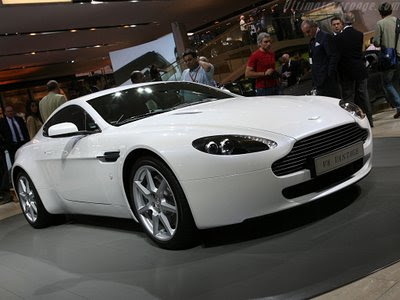 O novo Aston Martin V8 Vantage Sportshift
O Astom Martin V8 Sportshift foi eleito em Dubai, nos Emirados Àrabes, pela primeira edição do "Car Middle East Award" como o "veículo do ano".
Friday, March 26, 2010
Aston Martin DBS Wallpaper

Aston Martin DBS Images

Aston Martin DBS Wallpapers
Subscribe to:
Posts (Atom)


